Hello everyone!
The time has officially sprung forward and I had two cups of coffee. AJ is still on his up early kick.
As y’all know, AJ has been having quite a few trips to the doctors office and I’m beyond thankful he handles them like a champ! Even blood work, which I’m still so proud of him for.
Since this is fresh in my mind and we have another visit coming up, I figured it would be good to share how we got to the point of stress free doctor visits. It wasn’t always this way.
The Beginning
When AJ was younger, any type of doctor appointment was draining. Like I would go to the car and cry draining. I will say it and say it again, toddler years were the toughest years.
AJ was diagnosed right before two years old, so we had no clue how to prepare or plan for appointments. This resulted in meltdowns, self injury and just leaving a bad taste in everyone’s mouth for doctor appointments.
You have to remember, this is a time where a person could not even visit our home without setting AJ off (change in environment).
Once we started aba therapy and got educated on ways to help prepare AJ, things started to get a tiny bit better each time; landing us where we are today.
How to Prepare
There are several ways to prepare your child, yourself or loved one for upcoming visits. I would say this is more about easing any anxiety one might have.
If your child or loved one is too young or has a receptive delay (understanding of speech) then home rigging some “PECS” cards could be extremely helpful. I put PECS in quotations because what I’m about to talk about is more of a homemade version, compared to the actual PECS system.
PECS stands for Picture Exchange Communication System. Feel free to do some online digging if it interests you. I won’t go into detail here for the sake of not confusing anyone.
To make our visuals, I would take a picture on my phone or maybe even save an image of the doctors office off google, print it about 2×2 inches (you can print any size), and then laminate it. You can find decent priced machines at Walmart.

Along with printing & laminating pictures, I also laminated cardstock. The cardstock would serve as his “placer” for the item when the time came to complete the task.
This allowed me to show AJ a picture, along with verbally explaining what we were going to do & have him participate to make sure he was engaged.
A good example of this was preparing him for visitors. Like mentioned earlier, that was a huge trigger for AJ.
The conversation would be simple and go something like this:
“Look AJ, Grandma *have him touch and hold a picture of her* is coming over.”
I would then place it by him in eyesight as a reminder.
When I see grandma pull up and park, it would go something like this next:
*Excited voice* “AJ Grandma is here! Hurry let’s go match and tell her hi!”
Matching includes him taking her laminated picture and walking to the door where I would have the placement card.
When it would come time for us to open the door, I would have had AJ place the picture on the placement card and say:
“Nice matching! Let’s open the door and tell Grandma Hi!” *example below*

Proceed to open door and welcome her in.
This prep may sound a bit much but for him at that age, he needed that much visual prompting. It helped explain to him exactly what was happening and gave him control in welcoming the visitors into the environment.
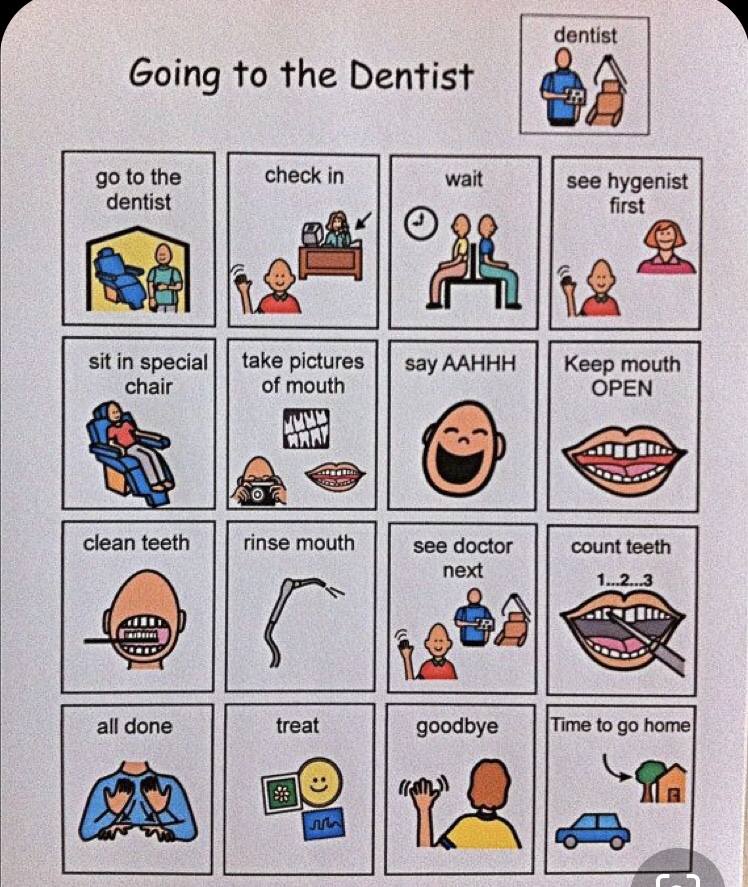
This example can be used for preparing for doctor visits. Instead of the card being a family member, it would be a picture of the dentist.
Remember, don’t forget to talk about the upcoming visit beforehand.
Have the child hold the picture of the dentist office, proceed to the car with the picture, continue to explain “we are on the way to the dentist” while driving and once arrived, have the child match the dentist card to their placement card.
Once you park, it would go something like: “Look we are here at the dentist, let’s match.” *Help child place the picture on their placement card and point to the building showing them they have matched and made it.
Older Individuals
If your loved one is older, the homemade PECS may be too much prompting. If they have good receptive skills, verbally explaining the upcoming visit as far out for the individual would be the best bet. Some need months of preparing, some need a day.
A great tip if you are preparing in advance to a more cognitive loved one would be using a calendar and reminding them every so often.
If your loved one falls in between not needing visual cards but not cognitive enough to understand the calendar, social stories would be great.
Social stories are short and sweet. Think of them as a paragraph with words and pictures explaining a trip in simple terms.
Preparing for Vitals
Now for the actual visit and hard part.
In all honesty, vitals gets better with more exposure. AJ has been to the doctors more than the usual annual visit. This plays a part in why he is so used to it with little anxiety. He has experienced it enough to know the run down.
This isn’t the case for everyone, especially not at first. Here is a helpful tip: prepare at home!
You can buy a pretend play doctor kit at the store. They usually come with a stethoscope, the thing to check ears, a thermometer & some even have a blood pressure cuff.
If not, many of these items are sold for cheap on Amazon. You may even go to your doctors office and ask for spare items to prepare your loved one.
**As much as you need to prepare your loved one, make sure you call your doctors office in advance to explain your needs for your visit.**
Back to home preparation.
Let’s just say start two weeks out for this example. You would have your loved one get comfortable with the items.
Have them touch the items at first. If it’s super new, they may not tolerate practicing vitals.
Each time take it a step further. The next step would be having them hold the items.
Then have them help you take vitals on a stuffed animal.
The last step would be having them get comfortable with you placing the items on them.
Pretend check their ears, blood pressure, temperature etc. and make it fun, all while reminding them about the upcoming visit.
Remember, these steps are over days or weeks. When doing this, don’t push it!
You want them to be comfortable. Once they achieve what you are looking for, stop for the day. THEN the next time take it a step further.
NEVER force them to do more than they are comfortable with. This will backfire and raise anxiety.
The end goal with practicing and preparing is to ease anxiety on what to expect.
That way when at the doctors, they are familiar with the building and the items used to take vitals.
Keep in mind, preparing is great but it doesn’t ensure success. It is always different in real time at the place. We cannot always prepare for environmental factors that may be going on that day.
We can only try our best as parents.
Things get better with practice. If your loved one likes routine like AJ, they will most likely learn that vitals are routine over time.
For example, AJ already knows they weigh him first. He will go back, kick his shoes off and stand on the scale before instructed.
There are endless ways to prepare for success. I will go ahead and stop here but feel free to reach out with any questions.
This blog may be a bit overwhelming. Just remember to take it one day at a time. If you are overwhelmed and nervous, kids pick that up. Breathe. Things will be okay!
I hope these tips help some. If you have great tips for preparing a loved one with anxiety for a doctors visit or event, let us know in the comment section.
Also, share this blog with anyone who may benefit from these tips 🤗.
Until next blog ❤
 RAISING OPPOSITES